
The Smuggler of Peru
2026

One of my most emotional, profound, and daunting journeys was to Peru. It is a vast, overwhelming country. It encompasses three climatic zones: the *Costa*—also known as the coastal desert—the cool, alpine Andean highlands (*Sierra*), and the hot, humid Amazon rainforest (*Selva*).

Each of these three regions presents a challenge in its own right. They beckon with magnificent landscapes, yet push me to my physical and mental limits—after all, I am no longer exactly young. And long before the universally renowned high culture of the Incas—a fact many are unaware of—these almost archaic-seeming landscapes gave rise to a multitude of advanced civilizations.

The Lady of the Nazca Lines

Traveling by coach from Ica, I head toward Nazca. There, I plan to see the Nazca Lines. More than 1,500 images stretch across 500 square kilometers. Passengers discovered them during the first commercial flights over the Nazca Desert.

It was only through the German mathematician and archaeologist Maria Reiche (*May 15, 1903 - +June 8, 1998) that a systematic investigation and uncovering of the lines took place.


Maria Reiche dedicated almost her entire life—and often her own personal resources—to the research, surveying, and protection of these geoglyphs in the Peruvian desert.
For this reason, she was affectionately known as "The Lady of the Nazca Lines." It is thanks to her dedication that the geoglyphs have been recognized as a UNESCO World Heritage Site since 1994.
This place rose to fame through the populist theories of Erich von Däniken — specifically, that Peru's Nazca Lines were ancient runways for extraterrestrials. In his 1968 book *Chariots of the Gods?*, he interprets the now-world-famous geoglyphs as navigational aids for massive spacecraft.

The scientific explanation is less spectacular and dates the lines to between 700 BC and 600 AD, attributed to the Paracas and Nazca cultures. The massive lines were created by removing the dark, iron-oxide-rich stones.
Scientists interpret it as a cult site for water and fertility rituals in this very arid desert.
Some of the lines point to an astronomical calendar, aligned with points on the horizon—where the sun or stars rise or set at specific times of the year (e.g., the solstices).
The Mummies of Chauchilla

Just under 30 kilometers south of Nazca—about six kilometers off Peru's main highway, Route 1—I arrive at the Chauchilla Cemetery. This is the only historical site from the pre-Inca era (200–900 AD) where one can view mummies of the Nazca culture in their original tombs. For this reason, it is also referred to as the "Cemetery of the Sitting Dead."

To this day, grave robbers plunder these sites to sell their loot profitably to wealthy collectors around the world. Archaeologists lack the financial resources and equipment to effectively protect the tombs.
Consequently, most of the tombs in this vast area have not yet been excavated. I have no idea why some people put a mummy in their living room display case.
It rebels inside me

Torn between the scenic beauty, the Pacific Ocean to the right, and the mountain passes to the left, my stomach is churning.
Nothing is more unwelcome than bowel trouble during a long bus ride that constantly shakes you around. Stopping isn't an option either, given the traffic and the cramped road conditions.
At least my timing with the hotel toilet before departure was spot on. Everything was taken care of just in time before we set off.
For extreme cases, I have my fast-acting Imodium akut tablets with me.
I was once tormented by severe diarrhea in the rocky desert of Libya, forcing the bus driver to stop every 30 minutes so that I could disappear behind a rock. On one occasion, a hiking group came around the corner. What on earth are they doing here?
In a situation like that, all of a sudden you couldn't care less—not to put too fine a point on it: you don't give a damn. Ever since then, I’ve always carried anti-diarrhea pills with me, but—knock on wood—I’ve never needed them again.
Damn high: "If possible, please turn around."

The Pan-American Highway, coming from Lima, always follows the coast towards Arequipa. The scenery is breathtaking. The road, with its steep, winding roads, is pretty stunning too.
Shredded tires and the occasional car wreck—strewn along the roadside or lying deep in the ravines below—point to a grim combination of mechanical failure and human error. The overestimation of one's own driving skills and the resulting accidents at the roadside are always cause for concern.

Just before the sleepy little town of Atiquipa, an overturned trailer laden with cables narrows the road. And a few kilometers further on, a vehicle had plunged into the depths just moments earlier. Rescue workers are rappelling down to the victim—or victims—while an ambulance and heavy machinery stand ready to salvage whatever can still be salvaged. But no ambulance in the world can save them.
The road is only two lanes wide, and the edge of the precipice is unguarded. Trucks, buses, and cars vie for time, tempting drivers into risky overtaking maneuvers. Ronny, a Peruvian tour guide, recounts how, just last year, he witnessed a tragic accident in which two tour buses veered off the road and plunged into the abyss. "If possible, please turn around."
Hotel on the Edge of the Abyss
Speaking of depths and a fear of heights: Anyone looking for a truly unique hotel experience will find exactly that at the Skylodge, located on the Carretera Principal Urubamba-Ollantaytambo. The hotel capsules—for that is the only way to describe them—hang suspended from a sheer rock face.

You are suspended several hundred meters above the ground, hoping that the ropes—and the entire structure—will hold. Just stepping outside for a moment is both ambitious and courageous. Further information:
For my part, I feel absolutely at ease down here on Mother Earth. After all, the Sacred Valley of the Incas lies about 2,900 meters above sea level.
Machu Picchu, you painting of stone and culture.

I sit for a moment on one of the massive boulders, let my gaze wander across the sprawling complex, and try to imagine what it was like here in times past. Almost hidden within the mists of the Andes, the sacred legacy of the Incas—Machu Picchu—reigns majestically above ancient stone terraces.
The last rays of sunlight bathe the terraces in a gentle glow, as if the sky itself were touching the proud heritage of the Incas with golden fingers.

Here, amidst the remains of these sacred walls, time stands still.
Only the wailing echo of long-silenced voices reverberates between the walls; they tell stories of former glory—of fame, of honor and ambition, of secret longings, wishes, and hopes.
People's concerns were the same as they are today. Only the props have changed.
Proud llamas stand guard, wandering through the ruins of a lost world.
Such is the beauty of this place, which touches the soul and gives flight to the imagination—Machu Picchu, you dreamlike painting of stone and mist, you poem of a vanished high culture, written in the clouds.
Romantically idealized notions—the kind held by countless travelers, myself included. Then, suddenly, the other side of the eternally repeating story emerges from the wisps of fog.

Assimilation: Resistance is futile

The Incas ruled their vast empire—which stretched from Colombia, Ecuador, Peru, and Bolivia to Chile and Argentina—for only about 100 years.
During this period, they assimilated approximately 200 ethnic groups and cultures.
The most significant peoples and cultures that were integrated into the Inca Empire were:
The Chimú on the northern coast of Peru—one of the most highly developed cultures of the time.
The Nazca peoples on the southern coast of Peru, who are known for their geoglyphs (earth or ground drawings).
The Chachapoyas, known as the Cloud Warriors, whose territory lay in the Amazonian Andes.
The Peoples of the Altiplano: These included various Aymara groups around Lake Titicaca.
You must cross over seven bridges.
The Incas had a clear strategy to expand their empire:

The Incas introduced Quechua as the official state language, which unified communication among the more than 200 ethnic groups.
The Incas promoted the worship of their sun god, Inti, and elevated him above local cults. Recognition of the Sapa Inca (Emperor/King) as the "Son of the Sun" was essential.
Individuals hailing from a subjugated culture could pursue a career in the army or administration through complete loyalty to and alliances with the Inca state.

Resettlement Policy (Mitma): To prevent uprisings and foster cultural integration, the Inca resettled entire population groups by moving loyal subjects into new territories—and vice versa.
The Incas expanded their empire by extending roads and constructing terraced fields and irrigation canals, which fostered economic dependence on the center. The capital was Cusco.

Local rulers were often integrated into the Inca administrative system; they were permitted to retain some of their positions of power, but were required to acknowledge Inca sovereignty.
When diplomacy fell on deaf ears, the use of force and skillful warfare likely contributed in no small measure to the expansion of the Inca Empire.
The Imperial Phase of the Incas, during which the empire expanded massively, began around 1400 AD and lasted until the arrival of the Spanish conqueror Pizarro in 1532 AD. The last stronghold of the Incas was conquered by the Spanish in 1572 AD.
The Dazzling Curse

The Inca kings staged themselves with impressive jewelry made of silver and gold, as was fitting for believers of the sun, according to their understanding. These must have been truly impressive appearances when they presented themselves to the common people, clad in their gleaming metal plates, necklaces, and earrings.

And that is precisely what led to their downfall. Not exclusively—but crucially so—because, in their eyes, the conquistadors—with their gleaming metal armor, their superior weapons, and their horses—must have been messengers of the Sun.
About 200 conquistadors were sufficient to bring down this vast empire under Pizarro.
Internal conflicts among ethnic groups and introduced diseases dealt the death blow to the Inca Empire.
The Catholic Church, with its ruthless proselytizing, took care of the rest.
On November 16, 1532, in the final Battle of Cajamarca, Pizarro ambushed Emperor Atahualpa and took him prisoner.
He was sentenced to die by burning at the stake—a fate which, according to Inca belief, would have prevented the immortality of the soul. Consequently, he consented to a Christian baptism, whereupon the sentence was commuted to death by strangulation.

The Andes are different

The Andes stretch along the west coast of South America for a distance of over 7,000 kilometers—from Venezuela to Tierra del Fuego. The natural landscape is diverse, featuring 6,000-meter-high (active) volcanoes, glaciers, high-altitude deserts, and tropical cloud forests.

The temperatures present a challenge to the flora and fauna, ranging from over 25 degrees in the lower regions to icy cold in the High Andes. The region is home to llamas, alpacas, guanacos, pumas, and the Andean condor—considered the king of the skies.

Above an altitude of 4,000 meters, plant growth is severely restricted.
Trees barely thrive anymore, with the exception of the introduced eucalyptus.
Characteristic of these high-altitude regions are Andean grains and Ichu grass. This tough bunchgrass serves as fodder for llamas and alpacas.
On my trip, I have to adapt to the different climate zones—and not just in terms of clothing.
In the desert regions, people are sweating, while in the mountain regions, the nights are bitterly cold.
In both regions, you should not forget sunscreen with a high SPF and headwear.
Altitude sickness presents a unique challenge. You shouldn't underestimate it and should prepare yourselves.

Altitude sickness
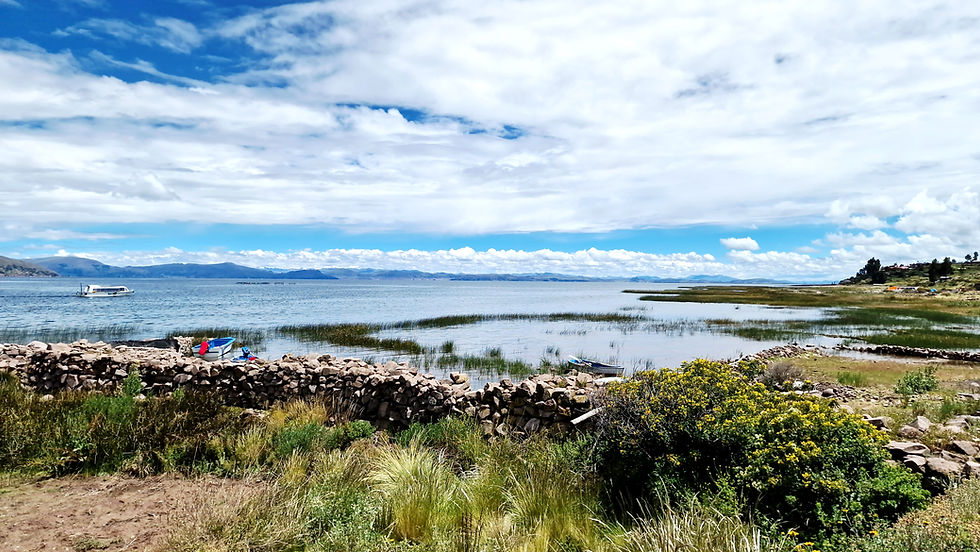
As I step off the bus at Lake Titicaca at an altitude of 3,800 meters, I feel a sense of lightheadedness. It feels as though I were tipsy from drinking alcohol. During the night, I wake up with a headache and slight shortness of breath. I feel as though my lungs are not taking in enough oxygen. Otherwise, I am spared major discomfort - even at 4200 m altitude - and after just one day I am largely acclimatized.

Travel above an altitude of 2,500 meters requires preparation for altitude sickness. It is caused by a lack of oxygen (hypoxia), particularly when the body is not acclimated to the altitude.
The body reacts with nausea, headaches, fatigue, dizziness, loss of appetite, and sleep disturbances—and, in severe cases, with accelerated breathing and heart rate.
Severe forms lead to shortness of breath, confusion, or loss of consciousness.
Altitude sickness can become life-threatening, for example, in the event of high-altitude cerebral edema (HACE) or high-altitude pulmonary edema (HAPE).
In that case, you must stop ascending and descend immediately.
As a precaution, I purchased Acetak at a pharmacy in Peru, where it is available over the counter. As a preventive measure, the guides recommend drinking plenty of water. I prepared myself a tea made with coca leaves and herbs. The locals chew the coca leaves; however, I chose not to do so. Coca leaves are available at almost every market. You are, however, not permitted to import them into Europe.

Alcohol is not recommended, as it intensifies the negative effects of altitude sickness. If possible, avoid physical exertion and take periods of rest.
The Smuggler of Peru

I am impressed by the beauty of the land, the people, and the cultural heritage of the many diverse ethnic groups. But eventually, every journey comes to an end. From Cuzco I fly back to Lima to take my time exploring the city and letting the trip sink in.

On April 15th, I head back to Berlin with KLM via Amsterdam. I don't need to re-check my luggage, but I do have to go through security screening again. I don't need to unpack my laptop anymore, because the equipment is state-of-the-art. There are security forces everywhere.
The Power of the Subjunctive II

While rummaging in my backpack, I have the impression that there is a packet of coca leaves, the kind you can buy at the market in Cuzco.
Coca leaves, coca tea, and coca candies may not be imported from Peru into Germany or the European Union.
The goods would be seized by customs. Importation may lead to criminal proceedings for a violation of the Narcotics Act.
Purely hypothetically speaking: What now?
I have the distinct impression that there is a trash can right before the checkpoint—but that the abundant security personnel would watch with keen interest as I disposed of anything. To say nothing of the surveillance cameras. This would certainly not be the moment to simply toss out a bag of coca leaves.

I would stow the bag with the leaves right at the very bottom—as if that would make any difference with those state-of-the-art scanners.
I would tell myself that the described leaves are merely tea leaves, lawfully acquired at some market in Peru.
Looking stupid is also supposed to help.
My backpack remains inside the machine longer than I expected and is finally spat out.
I expect a voice to discreetly call me aside. Nothing happens.
I would look around, grab my backpack, and go on my way.

P.S. Back home, there is a tin of coca leaves sitting on the shelf. I would brew myself a tea from them—one that tasted much better in Peru when combined with other herbs, but which, here in Germany, doesn't have any effect on me anyway. I really ought to travel to Peru again.
Tea End.


Comments