
Pridnestrowje
Updated: Jan 8
2025

Contrary to my usual practice, I booked a day trip to Pridnestrovye.
You're probably more familiar with the region as Transnistria. But our charming tour guide informed us that the name Transnistria is banned in Pridnestrovye because it's associated with atrocities committed by the Romanian occupying forces during World War II. Using it is a criminal offense.
Pridnestrovye, a state within a state, which admittedly no country in the world has recognized. It is politically, economically, and militarily dependent on Russia. Under international law, however, it belongs to Moldova.

Entry requirements: Anyone wishing to enter Pridnestrovye needs a valid passport.
At the border, you will receive a migration card, which must be kept until departure.
Pridnestrovje is evading the central government in Chișinău.
Western sources advise against travel there due to Russia's war of aggression against Ukraine, as the situation could escalate at any time.

Pridnestrovye's population is shrinking and is estimated at between 460,000 and 500,000.
Capital: The university city of Tiraspol, with 150,000 inhabitants, is the capital and the economic and cultural center.
Currency: The Pridnestrovian ruble, an unrecognized currency that is not convertible outside the country and is therefore about as sought after as stale beer.
Euros and the Moldovan leu are accepted as legal tender.
Tiraspol, the unknown capital

Tiraspol, the capital of Pridnestrovye, is something of a hidden gem among European cities—officially, it doesn't even exist.
Anyone who's ever been there is amazed by the relaxed atmosphere: hardly any traffic, orderly daily routines in this charming city that reveals itself upon closer inspection.
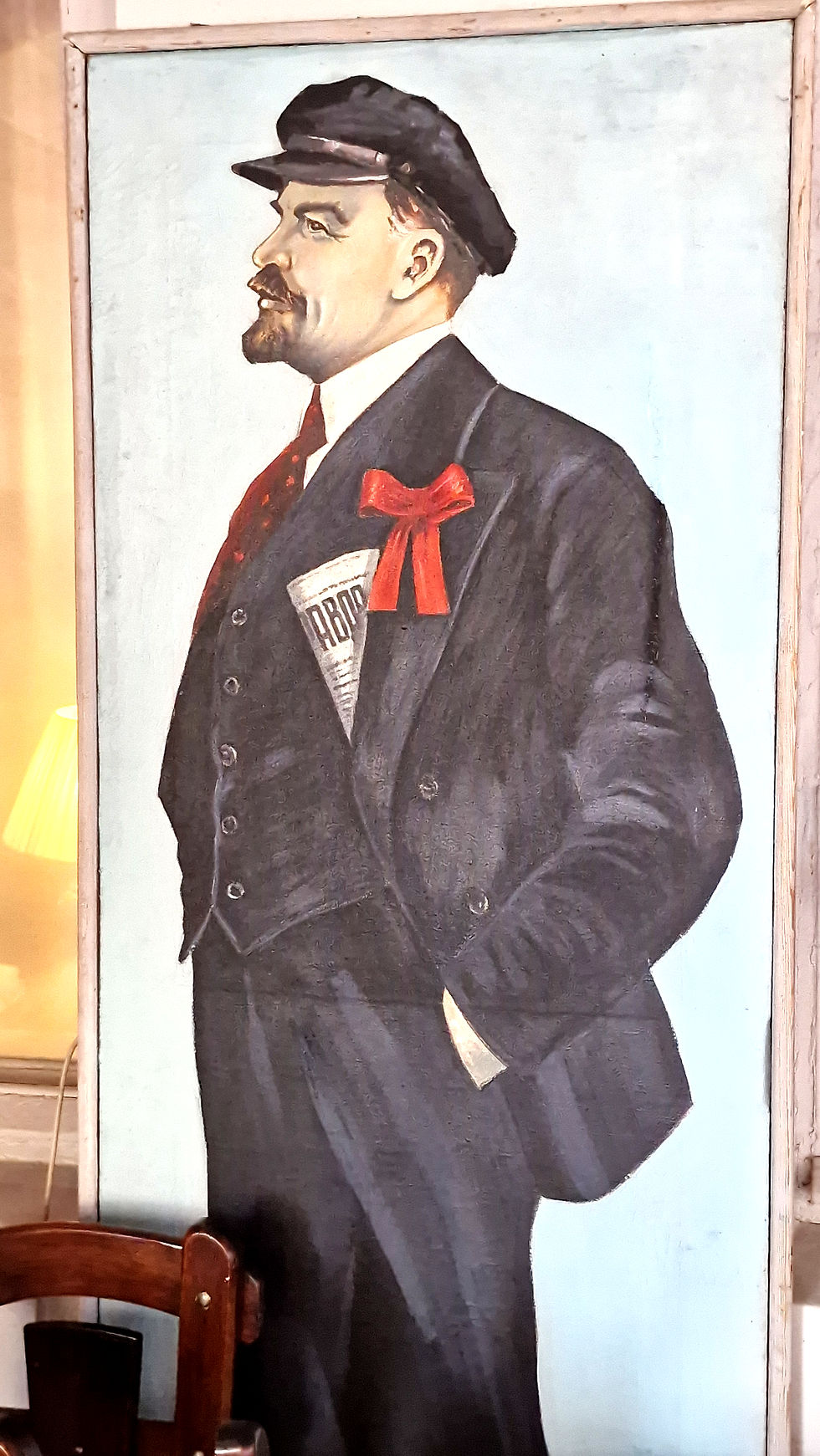
Tiraspol is reminiscent of a Soviet film set where the year 1991 seems to have stood still: Lenin statues everywhere, trams with a nostalgic charm, and small kiosks.

CCCP-Restaurant
My rating: *****
Sverdlova 54a, Tiraspol, Pridnestrowje (Moldawien)

You could also call it a history restaurant, because as soon as you cross the threshold, you find yourself in another time and another world. Parents will have to explain one or two props from the analog world and an analog era to their children.

For example, the hanging backgammon set at the counter is actually a slide rule, a kind of old-fashioned calculator. Forget it. It's a nice tourist restaurant. But not only that. Locals also like to come here, which I take as a good sign for good Russian cuisine.
Besides meat dishes like shashlik, they offer salads, borscht, fish, fresh bread, and vegetables. Just give it a try.

I assume the tasty beer comes from the historic brewery in Bender, Pridnestrovje. The dark beer has a pleasantly malty flavor and goes perfectly with hearty Russian cuisine.
Market day in Tiraspol: Melons, mamas and music
Those who arrive late will be punished by Babushka. So grab your best backpack and come to the Central Market in the wild east. You'll be rewarded with a wild symphony of sounds and smells.

The market is a vibrant labyrinth of stalls and aisles. Here you can find everything your heart desires—or didn't even know you desired! Fresh vegetables are piled high in pyramids, brightly colored fruit, more vibrant than any Picasso painting, and somewhere in between, market women and men lurk, offering their own wares.
Those who speak Russian soften people's hearts. Unfortunately, I don't understand a thing; I don't know what they're saying to me. Perhaps something like: "My honey is sweeter than love, try it! And take a loaf of bread while you're at it; it's fresher than your last romance!"

Before you know it, you'll be back at the bus with bags full of vegetables, stories, and maybe even a chicken under your arm. Life pulsates at the central market in Tiraspol, with prices that are negotiable. And once you've been to the market, you never forget it... not even your bathroom scales that tell you: "You've gained weight again!"

Monument and think about it
There are travel destinations with magnificent landscapes, others score points with their metropolises, their cultural offerings, their religion, and still others confront us with a multitude of monuments. Like here, for example, on 25 October Street.

They evoke a glorious past, venerating important figures and their cultural, scientific, or political achievements.
The saddest monuments of their kind are those commemorating long-past battles.
They often depict a group of heroic figures with outstretched arms and fists, emphasizing their resolve.
None of this is embodied by those monuments that commemorate countless tragedies. The pain of the victims and their bereaved can only be imagined.

Stunned and moved, one stands before them, staring at the arranged objects and their symbolism. Occasionally, small flames—as a sign of eternal remembrance—serve as a reminder of the victims.

The cover image of this travel blog says it all: a helmet with a spread-out flag on a granite block. A nearly wilted bouquet of flowers provides a splash of color, illustrating the contrast with the metal and stone.

These kinds of monuments are omnipresent. They tell the stories of people whose best years were still ahead of them when they were abruptly torn from their lives: for conflicts they bore no responsibility for. And idealized women, marked by suffering, admonish the caste of warmongers to finally stop. "Remember!"
But at some point, one simply stops remembering. At some point, only tourist groups—hurriedly driven by their guides—rush past these monuments, oblivious to their significance.
Too sad to pause for a moment.
At some point, the monuments are nothing more than perches for pigeons and their droppings. And then, in the distant future, not even that.
One would think that people would eventually learn from these memorials to human tragedies. One would think that we have now understood the mechanism of human error. Until the next generation erects the next memorial.

It's quite possible that time will force humanity to abandon this most repugnant of all human habits—
wars—because climate change is taking its toll, because natural resources simply can't regenerate anymore.
Or because some aliens pose an existential threat to humanity. Just kidding?!
I have no idea. Something like that. And on the last monument it says:
Think about it.


Comments