
In search of India: Delhi
Updated: Apr 13

2026
India is the seventh largest country in the world and, with 1.45 billion people, has overtaken China as the most populous nation. It impresses with its diversity of cultures, languages, religions, and landscapes: it unites tradition and contrasts, from the snow-capped peaks of the Himalayas in the north to the tropical beaches in the south, from the endless deserts of Rajasthan to the lush tea plantations in the east.

At the heart of the vibrant subcontinent lies the impressive metropolis of Delhi. As the capital of India, Delhi represents not only political significance but also a fascinating cultural diversity and an extraordinary historical heritage. And so our journey begins.
India: chaotic, hectic, loud; a constant struggle for physical survival turns Indians into shrewd traders of life. I have to acclimatize. The gigantic noise of the streets, honking everywhere, pushing and shoving, people running restlessly through the far too narrow alleys of the old city, which is overflowing with people. And exhaust fumes don't just cloud the smog-laden air.
Hotel

The hotel I check into after midnight bears only a rudimentary resemblance to the photos on the booking platform I used. The roads leading there become increasingly rough and narrow.
Puddles and mud suggest that it has recently rained. Dogs bark and watch me curiously as I enter the hotel.
At least someone is still here. The lobby resembles a warehouse. Sacks of food are waiting to be put away.
I enter my details into an oversized book, the kind Santa Claus might use.
A very friendly employee shows me to my room.
January nights are bitterly cold in Delhi.
This coldness is intensified here, in this room lit by cold white light and with its mirror-smooth tiles. There's a draft coming through the balcony door. But it's clean.
Delhi's road traffic: The journey is the destination

I can't even say what time of day there's no traffic on Delhi's roads. Driving here follows unwritten rules. Pedestrians are the lowest group in the hierarchy; here, the faster one counts, and in case of doubt, the stronger one.
Even crossing the street is an adventure, and the meaning of life is wonderfully redefined: the journey is the destination. And the same applies in reverse. Anyone who lingers at this crosswalk will be there until retirement.
Vomiting, eating, chilling: KFC

Out of sheer desperation, I venture a visit the friendly-looking, bespectacled uncle. After successfully crossing the street, the second part of our jungle training begins: surviving a meal at KFC.
Psychologists have allegedly discovered why burgers are so successful at the major fast-food chains: the bun reminds us of a woman's breast to the touch: they are so soft and cuddly.

This branch must be a very old one, no, very, very old, practically ancient. Because as soon as I peeled the burger off the wrapper, it crumbled through my fingers. What am I saying? No, the bun disintegrated before my very eyes. So I quickly took a bite.
Yikes! Beneath the crispy breaded skin, I bite into slippery, swollen chicken meat that seems to be 90% water. After I've finished eating (otherwise there won't be any nice weather tomorrow), it's a matter of waiting and surviving the next 24 hours.

In the streets of Delhi
Depending on where you are in Delhi, it is either very well-maintained and spacious, such as in the diplomatic, villa, and government districts with their generously sized parks, expensive shops, and cafes, or quite the opposite. India has a steadily growing number of wealthy people who consume heavily and travel extensively.

In my case, in my neighborhood, it's loud, stuffy, and cramped. Away from the business centers, there's a smell of urine, left behind by many of the less privileged here, forming small puddles in the potholed streets. It is therefore advisable to wear sturdy footwear, not only because of the indicated footpaths, which are so rough that I prefer to walk on the side of the road.

An old woman sits on a stone surrounded by her family, neighbors, or friends and blows me a toothless kiss.
The group is all the more delighted because I reciprocate her advances. We flirt, much to the amusement of the others.
Before things get too intense, I wave and continue on my way. I should also note several times that the Indians are a very polite and helpful people, which almost makes a Western European like myself suspicious. But it is genuine hospitality.
The friendliness of Indians is even more pronounced outside the big city, in the smaller towns and villages.
People are delighted by visitors. They wave with a smile or shake hands and ask where you're from.
The burden of life

The alleyways of Old Delhi are very narrow and winding, and crammed with small shops, just like in a souk.
Huge quantities of food are traded here. Nothing would function without the porters who transport individual sacks or entire cartloads from one place to another. They risk their lives and bend their backs.
To outsiders, it might seem like a bustling beehive. But everyone here has a specific role in the gigantic machinery of the business world, from the day laborer offering his services as a craftsman to the savvy businessman.
Even the young women, with their small children in their arms, pursue their business model and earn their living by begging.

Outside the major cities, it's significantly cleaner. But plastic waste is ubiquitous, whether in the city or the countryside. Like the many free-roaming cattle, it's a common sight.
But nobody wants to clean up the trash anymore, an Indian tour guide tells me. It's—hard to believe, I know—difficult to find staff for it.
In my opinion, busy public places are safe after dark.
However, this does not apply to dark, secluded areas and slums. It's common knowledge. People lack basic necessities. And unfortunately, as in most megacities, suffering spreads unchecked here as well.
Delhi is growing due to the never-ending exodus from rural areas and is now home to 36 million inhabitants! Berlin is a village by comparison.
You want it spicy?
Theoretically, I can eat very cheaply for just a few rupees a day. Small food stalls attract hungry customers everywhere. The food is usually freshly prepared. For whatever reason, I'm foregoing a tasting this time. I have a tour planned, and I can't afford any potential stomach problems.

India is a rich country. It produces more food than it consumes: milk, pulses, fruits, vegetables, and grains. Food production is a major pillar of the economy, and much of it is exported.
The country is world-famous, and infamous, for its wide variety of spices and spice blends. They are sold by the sackful in the markets.

When an Indian restaurant's menu says "spicy," it's not the same as the Indian dishes you'd find in a European Indian restaurant.
In India, "spicy" means extremely hot—enough to make your eyes pop out of their sockets, swell red, and weep with tears reminiscent of Niagara Falls.
If the waiter asks whether you are sure you want the Indian version or a milder one, you should opt for the milder one.
At least at the beginning. You can always increase it later.

The country with the most vegetarians is India. This is related to the deep religious beliefs of the Indian people, rooted in Hinduism, Jainism, and Buddhism.
Jainism is one of the oldest religions, dating back to around 600 BCE, and teaches strict non-violence and asceticism.
Cattle are considered sacred and are not slaughtered.
The German proverb "Bleib doch, wo der Pfeffer wächst!" (Stay where the pepper grows!) is an exhortation to disappear and not return. The saying originates from the time of the spice trade with India, around 1500 AD.

You need to sharpen your scythe: etiquette and taboos

India is a very tolerant country. Mutual respect, courtesy, and hospitality are important characteristics of Indian society.
Family is central to people's lives, and marriage is the highlight of their lives. It is associated with immense expectations from parents and the desire to maintain social status.
Weddings are an industry in India. Couples pose for cameras in Bollywood style; numerous agencies and beauty salons specialize in making them look their best.
A wedding rarely has fewer than 500 guests who need to be fed.
Very wealthy families, of which there are an estimated 1 million income millionaires in India - and the trend is rising - rent ballrooms in expensive 5-star hotels or book entire palaces.

There are clear expectations for the children, especially regarding adherence to gender roles. Bearing sons was the goal, because girls could ruin a family, as the parents had to pay the groom—depending on the social standing into which she married—a substantial dowry.
The family is sacred, idealized, and paradise itself, provided the woman bears sons. Because of these circumstances, the parents had the sex of the child determined during pregnancy.
If the child was a girl, it was aborted.
Prime Minister Narendra Damodardas Modi, who has been in power since 2014, has very decisively put a stop to this.
Doctors are prohibited from disclosing the sex of a child to the parents before birth. Those who violate this law lose their medical license, face severe fines, and – depending on the severity of the offense – may end up in prison.

The idealization of the family is a new trend, not only in India.
Women who choose careers, couples who live without being married, men and women who reject arranged marriages, gay, lesbian, and transgender people who see no future for themselves in the rigid structures of tradition and reject them, face considerable social opposition.

The promised paradise of family can quickly turn into hell and an ordeal for social outcasts. But even here, old social barriers are slowly crumbling, especially in major cities.
The key? Education and work.
Spoilsports
Nothing frightens Indians more than the curse of beggars. These deeply religious men and women work their entire lives on their good karma. After all, who wants to be reborn as a toad or Donald T.?
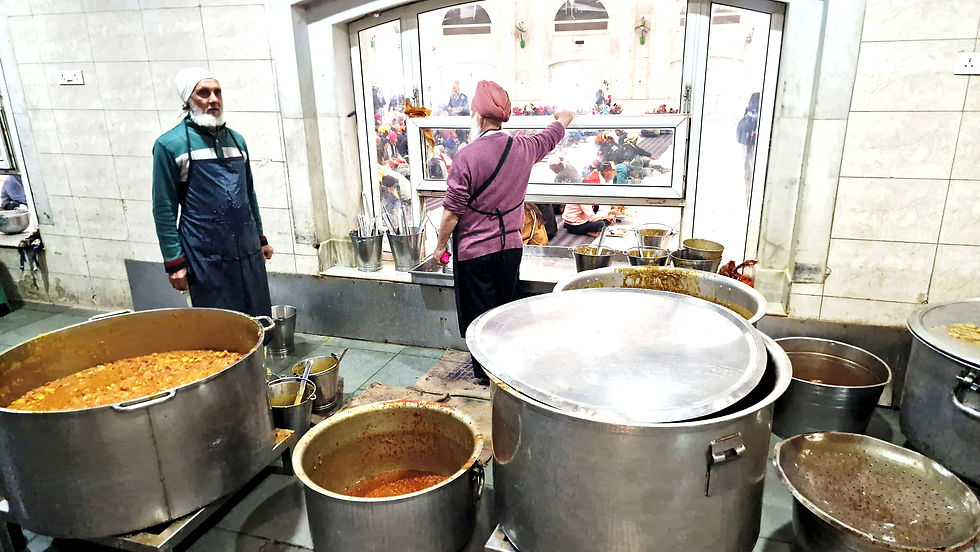
That's why they donate, so as not to be cursed by someone who has to live on the streets. And once their daily donation budget is exhausted, they move on, politely and humbly. Under no circumstances should they be rude. Because the next life could make you homeless yourself through some careless mistake.
However, the hardship on the streets of India is immense. This doesn't make the matter of compassion any easier. Here, too, the rule is: do as the Indians do and learn by observing.

Someone who is missing

Mahatma Gandhi is omnipresent. He is India's founding father and a guiding figure. Like no other politician, he stood for non-violent resistance against British colonial rule. This was his hallmark, with which he led India to independence on August 15, 1947, after 200 years of British colonial rule.
I am going to the Mahatma Gandhi Museum, Gandhi Smriti, Raj Ghat, New Delhi, Delhi, 110002, India. The building resembles a barracks and displays historical documents and photographs.

Not to be confused with the National Gandhi Museum, Jawaharlal Nehru Marg, opp. Raj Ghat Memorial, New Delhi, Vikram Nagar, New Delhi, Delhi, 110002, India.
It is located not far from the Mahatma Gandhi Museum. Here, in addition to historical facts, you can admire the exceptional politician's telephone, shoes, glasses, and even his dentures.
Even in death, this man remains so approachable and human.
His humility in the later years of his life still evokes a sense of melancholy, even today—amidst all the toxic warmongers of our time.
Gandhi is someone we miss.


Comments