
Karim, the pearl diver
Updated: Mar 4
Qatar on the Persian Gulf
Open one eye when you sell,
and both eyes when you buy.
Qatari proverb
2026

Souq Waqif
My rating: *****

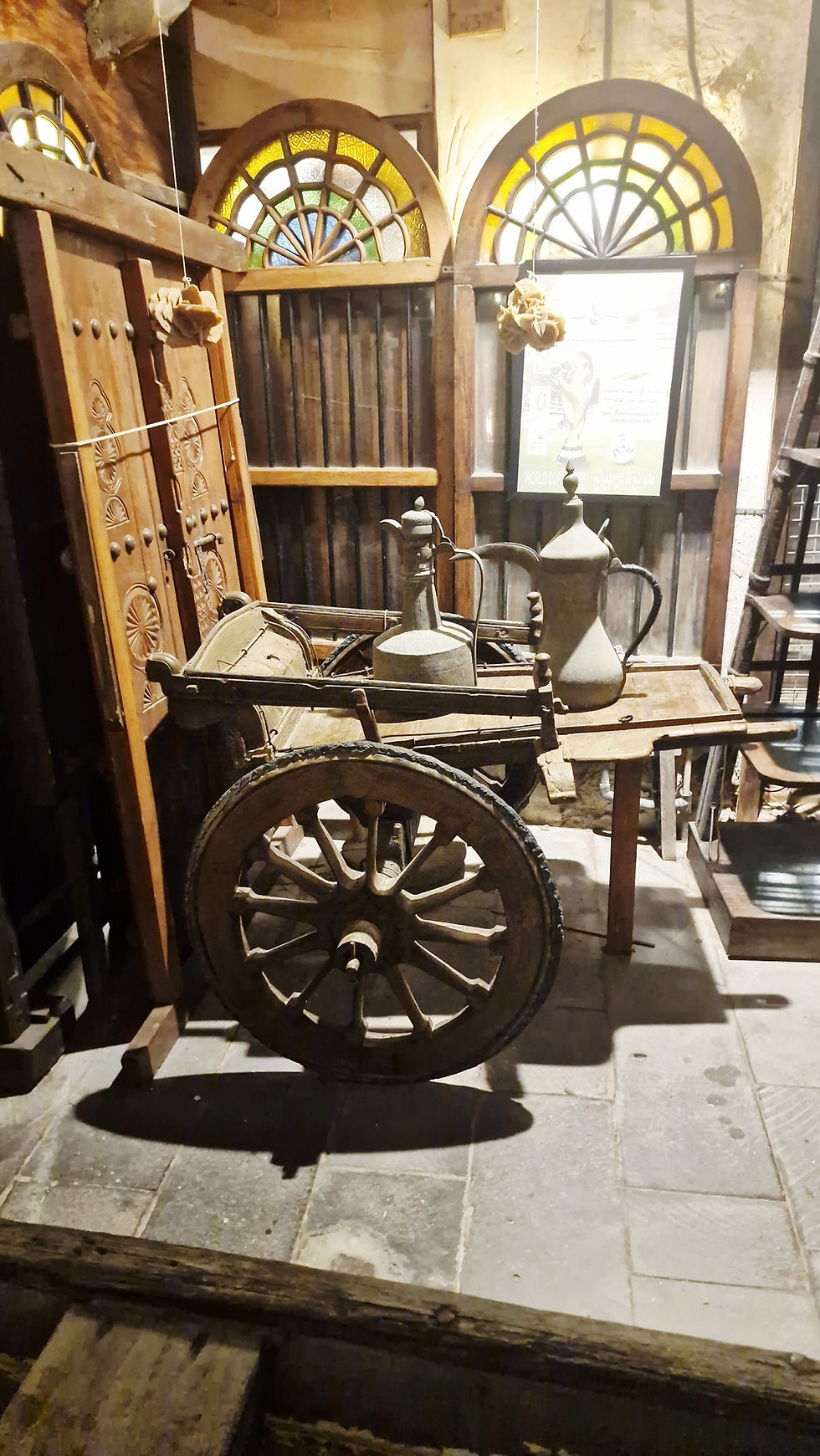
The souq is over 100 years old and was the trading center for livestock, pearls, spices, and everyday goods for the small settlement of Doha.
Souq Waqif means "standing market" because it was frequently flooded. It burned down in 2003 and was faithfully restored over two years, beginning in 2006.
Unlike the touristy souqs in Dubai, this one successfully blends modernity and tradition and is gratefully received by the locals.
One positive aspect is that hardly any vendors bother me. I can stroll through the narrow streets in complete peace, without anyone pulling at me or engaging me in conversation.
Bad Finger

The oversized sculpture of a thumb is also helpful for orientation.
I don't quite grasp its meaning. Perhaps the sculpture is a reminder that in times long past, people signed with their thumbs.
Far from it: The bronze sculpture by French artist César Baldaccini commemorates the Qatari national football team's victory at the 2019 Asian Cup. Be that as it may.
In any case, the sculpture serves as an excellent landmark in and around the souk.
Besides the usual shops for textiles, household goods, spices and perfumes, there are countless cafes, restaurants and boutique hotels.
Art full: Souq Waqif Art Center

You can find it practically on every street corner: art.
From the architectural masterpieces of modern and classical buildings: They are simply beautiful to look at. And it's free.
You'll constantly encounter a wide array of sculptures, some of which are a matter of taste. Some are spectacular. Looking at them is free.
At Souq Waqif Art Center you will find high-quality paintings of various styles. The building truly comes alive in the evening.
Then you can also look over the artists' shoulders as they work on their creative projects. With enviable tranquility and completely captivated by what they are doing.
Immoral offers
The souq offers a wide variety of goods: food, textiles, household items, handicrafts, perfumes, spices, even a bird market, and of course tourist souvenirs and much more. The numerous cafes, restaurants, and street food stalls make this type of shopping experience enjoyable.
I'd like to mention a café here because they offer freshly made sweets, like the ones we buy at the Turkish shop around the corner. But the atmosphere here simply inspires you to slow down and take it easy.

Opposite the bad finger you will find the café:

Anyone already struggling with weight issues doesn't need to worry about it now.
However, you can definitely start losing weight in the following week or finally put those New Year's resolutions you ignored into action.
At least there's now salvation from the pharmaceutical industry: the much-discussed diet injections, which are known to suppress appetite, offer a lifeline in times of need.
Alternatively, a diet pill is supposed to be available soon. Or is it already on the market?
Alternatively, you can do what I do: simply eat less.
You can probably tell: immoral offers.

Orientation


The souq is relatively large, but there's no need to worry about getting lost. Wide pedestrian zones structure the area.
It's best to take note of prominent landmarks, such as the Old Fountain or the aforementioned striking thumb sculpture. However, this is essentially unnecessary, as all the winding alleyways inevitably lead back to one of the main streets.
Furthermore, there are service and security personnel on every corner.
Karim, the Pearl Diver
I was wandering aimlessly through the narrow, winding alleys of Souq Waqif when I noticed a group of men smoking.

There's still a free seat, and I haven't smoked shisha in a long time. The men nod at me kindly. To my left sits a gray-haired man, perhaps around 80 years old, with gentle, benevolent eyes, who introduces himself as Karim. His story goes like this:
When I think back to the time of our grandfathers and fathers, pearl diving was once the most important source of income in Qatar.
The work was arduous, dangerous, and dependent on the whims of the sea. I want to tell you about my father, Karim, the pearl diver, so you can understand how we lived and worked.
In the 1930s, with the discovery of cultured pearls, our profession was nearing its end. This led to a noticeable increase in economic hardship in our country.

We pearl divers lived with our families in small huts on the beach. They were made of wood and bamboo and had two rooms.
Our kitchen was outdoors. We fetched water from the well, and in the evenings, kerosene lamps provided their meager light. The house smelled of the sea and salt, but the proximity to the ocean gave us freedom and a sense of community.
Even in the time of my uncle, who traveled with his family through the endless desert, our people lived off what the land provided: fishing, trade, and pearling.
My uncle wasn't a big fan of pearl diving. He needed the vastness of the desert, the silence, and the starry sky that spread across the land like a carpet.

The first light

Sometimes I was allowed to accompany my father pearl diving. Our days began as soon as the first light appeared on the horizon. Our nakhuda, the captain, would wake us before sunrise. Sleepy but full of anticipation, we prayed together on the deck of our dhow. Breakfast was simple—usually just a few dates, a piece of bread, and some water. But it had to be enough to fill our stomachs.

My father used to tie a bone clamp to his nose to keep the water out. A simple cotton cloth held his thin loins together. We attached the heavy stone, which we called "Jibaal", to a rope so that he could quickly pull it down into the depths. Another rope connected him to the boat—a basket for the oysters hung from it.
The dives

After the preparations, it was time to get in the water. I can't even tell you how much courage it took to jump into the depths. With the Jibaal harness strapped to his foot, he plunged ten, sometimes even twenty meters, into the abyss of the sea.
His air never lasted long, maybe a minute or two, then he'd tug on the rope, so his comrades would quickly pull him back up. Barely back on board, he needed a short rest – but there wasn't much time, because the next dive was already waiting.
Lunch break and relaxation

At midday, when the sun beat down mercilessly, we took a well-deserved break. Our meals were very simple compared to today's standards: rice with fish or some dried meat. Sometimes we slept for a few minutes on the wooden deck to gather strength for the afternoon.
In the afternoon

The dives continued into the afternoon. Our bones grew heavy, our muscles tired, but the dream of that one big pearl drove us on.
He repeatedly dove down, feeling the current, the cold, sometimes the burning pain of jellyfish or cuts through coral.
I often heard about injuries, and I'll never forget some of the encounters with sharks.
My mother's fear for my father caused deep worry lines to appear on her face, especially during multi-day dives.
Evening return

With the sunset came relief.
He washed the salt off his body—as best he could with the last of the fresh water—and prayed with the others.
Afterward, the divers carefully opened the oysters they had collected. I can tell you: Happiness lay in the little things. Far too often, the shells remained empty.
But every time my father found a pearl, his heart beat faster.
Nighttime rest and community

In the evenings we sat together, ate a little something, told stories, or sang old songs. The camaraderie helped us forget the hard day. And then, under the starry sky, we lay down to rest, ready to begin again the next morning.

My father's life as a pearl diver was marked by hard work, deprivation, and danger—but also by solidarity and hope.
Pearl fishing was more than just a job for him. It shaped us as a community and held our small country on the Gulf together.
Update Dark clouds in the sky over Doha
At the end of January, I left Qatar for India. What I could only vaguely sense at the time was a full-blown conflict between Israel, the USA, and Iran. By early March 2026, a war threatened to sever the foundations of the entire Gulf region and global trade.

Thousands of tourists are stranded because air traffic in the entire region has been suspended.
The stable economic and political conditions are deteriorating. A new war threatens world peace once again.


Comments